Gen AI Implementation Roadmap
Mid-Sized Enterprise (ERP-Centric)
#GenAIhashtag#Implementationhashtag#
Gen AI Implementation Roadmap for mid-sized enterprise (ERP & AI)
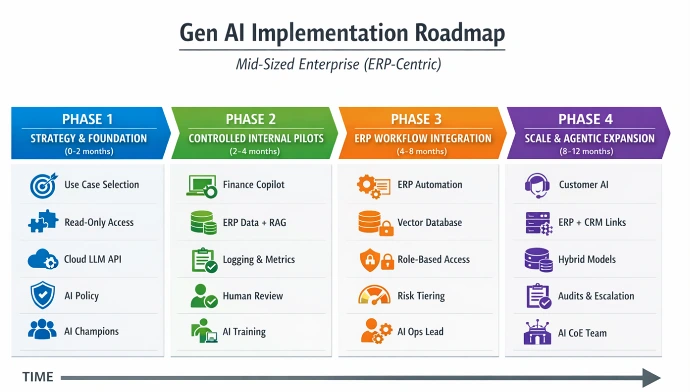
Generative AI is revolutionizing the mid-sized enterprise landscape by augmenting core ERP functions within systems like Odoo and SAP Business One. This strategic implementation follows a four-phase journey designed to balance rapid innovation with rigorous risk management, ensuring that AI becomes a reliable partner in finance, inventory, and procurement workflows.
Phase 1: Strategy and Foundation
The initial two months focus on establishing a secure environment and identifying low-risk use cases, such as automated report explanations or SOP assistants. During this stage, the organization implements a read-only integration using proprietary cloud LLMs (like GPT-4 or Claude) to interact with existing ERP reports and documents. Governance is a priority, requiring the appointment of a Gen AI Product Owner and the creation of an AI-acceptable use policy to ensure all AI-generated outputs are manually verified before use.
Phase 2: Controlled Internal Pilots
Between months two and four, the focus shifts to internal pilots like finance copilots and ERP helpdesk assistants. Integration evolves into Retrieval-Augmented Generation (RAG), where a vector database stores ERP document embeddings to provide contextually accurate, grounded answers without "hallucinations." This phase maintains a strict "human-in-the-loop" requirement, aiming for a 20–40% reduction in task time while training ERP super-users to validate the system's accuracy.
Phase 3: ERP Workflow Integration
From month four to eight, the AI is deeply embedded into operational workflows to support decision-making in inventory management and procurement. The system becomes context-aware, utilizing ERP APIs to understand specific transaction IDs and user roles. Technically, this involves a transition toward structured RAG and Named Entity Recognition (NER) to extract data like invoice numbers or supplier codes. KPI targets include a 30–50% reduction in manual ERP analysis and significant time savings in month-end financial closing.
Phase 4: Scale and Agentic Expansion
In the final stage (months 8–12), the organization scales to customer-facing AI and limited agentic workflows, where AI can plan and execute actions like ticket routing or follow-up reminders under supervision. A hybrid LLM stack is deployed, using proprietary models for complex reasoning and open-source models for high-volume internal tasks to optimize costs. Success is measured by a 30–60% faster support response time and a total cost-to-serve reduction of up to 30%, supported by a dedicated AI Center of Enablement.
hashtag#EnterpriseResourcePlanninghashtag#SMEhashtag#SMBhashtag#ERPhashtag#AI
hashtag#ArtificialIntelligencehashtag#AdonAITraininghashtag#Adonaihashtag#Trainingere...